
A Game Changer for Tackling the Living Wage Gap — Globally
Fiona Dragstra, General Director of the WageIndicator Foundation, shares how the NGO is providing updated, publicly accessible living wage estimates across 166 countries. Working with trade unions, employers, companies, and other living-wage stakeholders around the world, WageIndicator is helping to close the living wage gap globally.
Though the concept of a “living wage” dates back to 1919 when the preamble of the International Labour Organisation’s (ILO’s) Constitution called for “the provision of an adequate living wage,” it has taken almost a century for this movement to gather true momentum. The ILO’s adoption of principles on estimating living wages in March 2024, gives new wings to those who have long advocated for progress on this issue.
The rising cost-of-living across the world has deepened wealth inequality globally. According to the Business Council to Tackle Inequality, the top 10% of earners take home over half of total global pay, while the bottom 50% earn just 8.5% of that pie. In many economies that contribute massively to global supply chains, large numbers of workers live in poverty: 58% in Mozambique, 37% in India, 33% in Mexico, and in Europe one-in-ten is at risk. The payment of fair compensation can spark virtuous cycles that benefit workers, businesses and, subsequently, society at large, giving rise to stable, resilient, reliable, and better performing value chains and sustainable business practices.
Growing recognition that statutory minimum wages often fail to cover peoples’ basic needs has bolstered increasing support for the living wage movement. According to WageIndicator’s April 2024 data, in only 26 countries the lowest applicable statutory minimum wage was equal to or exceeded our living wage estimates.
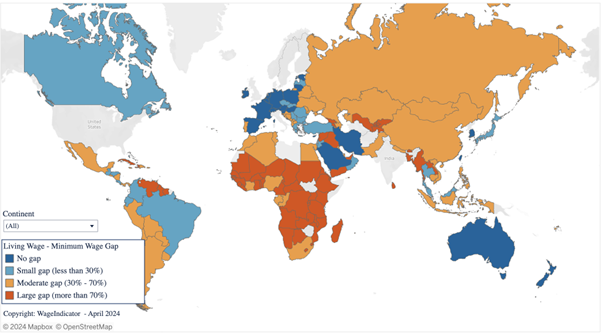
Scaling living wage estimates globally
At WageIndicator Foundation we have worked on living wages for over a decade. This was a logical step after creating globally comparable databases on Minimum Wages, Wages and Salaries, Labour Laws, and Collective Agreements, all aimed at enabling global labour market transparency through publicly available data resources. Our first living wage release in 2014 provided contextualised living wage data for 80 countries; our latest release in April 2024 provides regional level data for 2700+ regions across 166 countries.
We calculate living wages by estimating the costs of goods and services needed by workers and their families for a decent standard of living, contextualised for regional socio-economic realities. We devise estimates for a variety of family types and update our data on a quarterly basis through face-to-face and online data collection by some 300 data collectors across the world. We welcome the principles as set out by the ILO Governing Body, noting the importance of strengthening social dialogue and collective bargaining in operationalising the living wage, as well as promoting incremental progression from minimum wages to living wages.
Living wages as a linking pin in the SDGs
The living wage movement has not been solely driven by advocacy from NGOs and trade unions, nor by goodwill gestures from companies. Instead, it has emerged at the forefront of global agendas around sustainable business. Crucially, paying a living wage can be a linking pin for several of the UN Sustainable Development Goals (SDGs). Though they most directly link to SDG 8 (Decent work and Economic growth), SDG 1 (No poverty), and SDG 10 (Reduced inequalities), they are also contributory to SDG 2 (Zero hunger), SDG 3 (Good health and well-being), SDG 4 (Quality education), SDG 5 (Gender equality), and SDG 16 (Peace, justice, and strong institutions).
The significance of a living wage in advancing these goals underscores its integral role in enabling sustainable development and social progress. The UN Global Compact’s Faster Forward initiative highlights living wages as one of the five key ‘areas of action’ for corporate responsibility. Guiding businesses in aligning their strategies and operations with the universal principles of a living wage, gender equality, climate action, water security, and sustainable finance, the Faster Forward initiative supports integrating living wage policies throughout an organization's workforce as well as its supply chain.
This is similarly emphasized by sustainability reporting requirements imposed by recent and upcoming legislation such as the European Corporate Sustainability Reporting Directive (CSRD) and the Corporate Sustainability Due Diligence Directive (CSDDD). These regulations compel companies to disclose their social impact and ensure due diligence for human and environmental right violations across their supply chains, including efforts to ensure fair and adequate wages. By fostering transparency and accountability, such measures contribute to the broader aim of promoting corporate responsibility and ethical business practices.
How are companies and investors responding to these developments?
Companies, for their part, are increasingly committed to paying a living wage. And they are increasingly communicating that commitment publicly. PwC and WageIndicator’s Global Living Wage Survey 2023 found that 67% of businesses considered living wages a priority for their organisation and that 54% expected to make relevant commitments within the next five years.
Companies such as Fairphone have emerged as leaders in this movement, making ambitious and public commitments to the cause. Unilever, as well, made its first Framework for Fair Compensation in 2014, pledging to pay all its employees a living wage. And they expanded this ambition across their entire supply chain, aiming to require all their suppliers to pay their workers a living wage by 2030.
Ball Horticulture, a family company that works with over 8,000 individuals across over 30 regions globally, is another powerful example of putting these data in positive change. Unsure if their compensation policies met decent living standards, they approached WageIndicator in 2021. Ball Horticulture now uses WageIndicator’s Living Wage database to drive living wage commitments across their entire supply chain. After surveying 30 locations and identifying wage gaps in nine geographic areas, they have already implemented living wage policies in two regions and have devised action plans to accomplish the same for the rest. Using WageIndicator's living wage estimates, they negotiated with supply chain managers reluctant to pay more than minimum wage, showcasing the measurable negative impacts of inadequate compensation. While they're still addressing second-order effects like wage structure revisions and cost impacts, they are optimistic that improved wages will reduce attrition, cutting hiring and training costs. They believe retaining experienced workers will ultimately benefit consumers with better products and higher quality services.
Living wages are also gaining prominence in the investment landscape, as recently highlighted by the Swedish Buffer Fund, AP2. Their analysis indicates that while addressing social issues might seem challenging, the concept of living wages provides a clear and quantifiable metric, making it easier to track and enable effective policies and progress. Incorporating living wages into their investing approach allows them to engage with companies on human rights and supply chain issues, regardless of their geographical location. For them, paying a living wage is crucial for evaluating true company performance and ensuring fair competition across markets. As it should be for all.
Publicly available living wage estimates
The challenges associated with living wage commitments and implementation should not be underestimated. Many companies that started working on living wage implementation in their supply chains encountered the difficulty of having access to publicly available, consistently updated and regional living wage estimates at scale.
At WageIndicator, we made a first step to address this issue and therefore as of 1 May 2024, we have published our living wage estimates for over 2700 regions across 166 countries. We make these data publicly accessible to all, in the hope that the availability of updated estimates can empower wage negotiations and collective bargaining globally — facilitating the implementation of living wages everywhere.
In addition to making these living wage estimates publicly accessible, we continue our work together with trade unions, employers, companies, and other stakeholders in the living wage movement to demystify living wages. Of course, we would not be WageIndicator if our aim was not to continue to expand and maintain our living wage database — to ensure that these data remain publicly available, enabling equal access to this vital information for all.
About the Author:
Fiona Dragstra,
General Director, WageIndicator Foundation
PHOTO: Garments Factory, Bangkok | 1000 Words, Shutterstock | WageIndicator
Read perspectives from the ISSP blog