Mackenzie Mindel - SEA Case Story

Interested in earning your SEA credential? Download our free sample of the SEA Study Guide or sign up for the next SEA Study Cohort.

What brought you to this moment in your career where the Sustainability Excellence Associate (SEA) made sense for you?


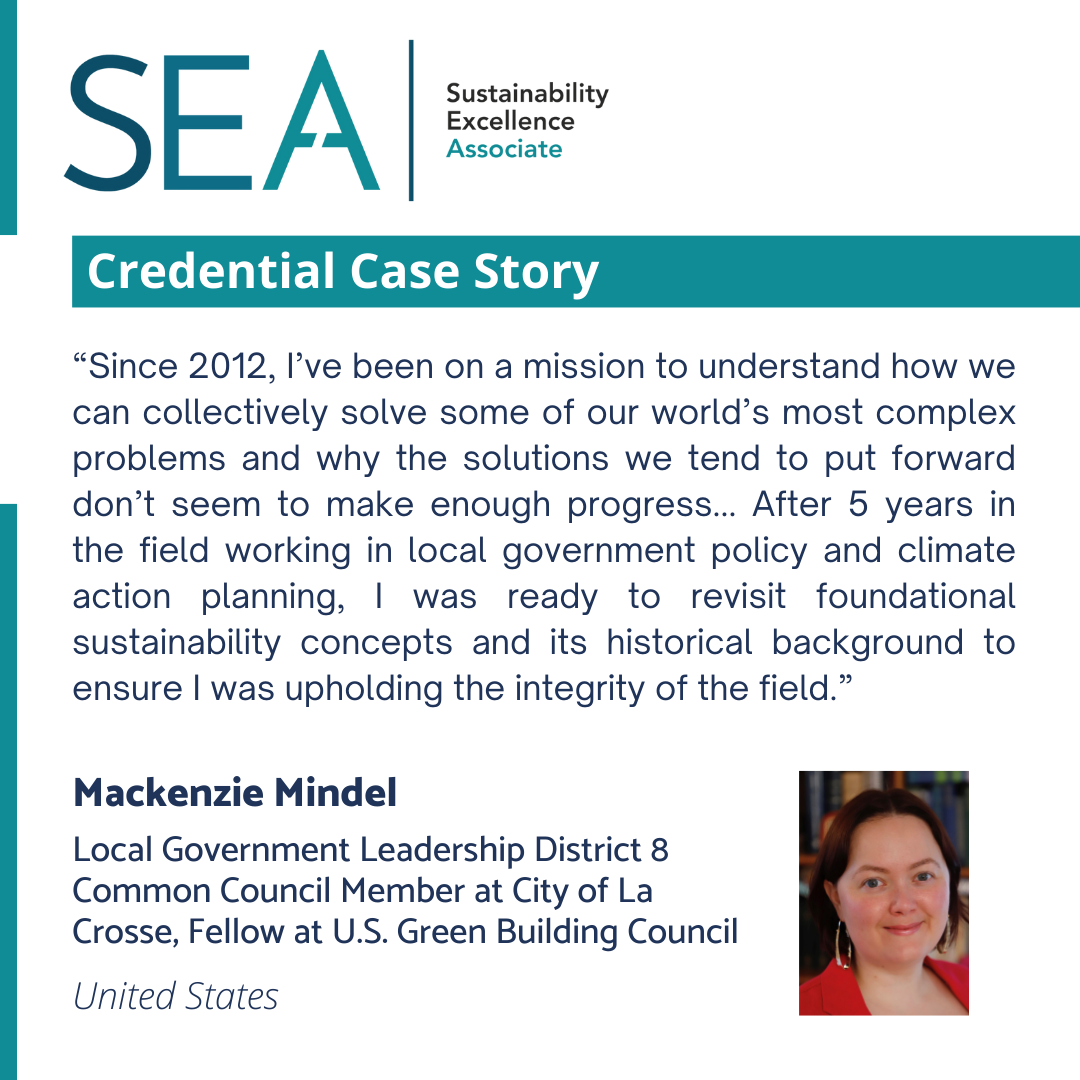
Since 2012, I’ve been on a mission to understand how we can collectively solve some of our world’s most complex problems and why the solutions we tend to put forward don’t seem to make enough progress. This foundational concept led me to completing a bachelor’s degree (2017) in Philosophy, Sustainability and Environmental Studies, and Chinese Language and a master’s degree (2019) in Social Innovation and Sustainability Leadership. After five years in the field working in local government policy and climate action planning, I was ready to revisit foundational sustainability concepts and its historical background to ensure I was upholding the integrity of the field. 


How are you putting the knowledge, skills, and ability demonstrated in the SEA to work in your career (or work) today?


After working in the sustainability field for five years and spending less time focused on the historical background or fundamentals, which I had spent so much time studying in my undergraduate and graduate education, I felt the desire to reconnect with the core concepts and historical richness of sustainability. The pandemic presented major human and societal challenges, and it also brought Greenhouse Gas emissions on a downward (albeit temporary) trend for the first time in decades. The federal government also mobilized historic levels of capital to achieve the most aggressive climate actions at scale in history. Those contributions have created arguably the most exciting and innovative habitats for the sustainability professional to work in. As exciting as it is to work in this field right now, I was eager to re-ground myself in the basics of sustainability, and the Sustainability Excellent Associate (SEA) was the perfect opportunity for me to settle back in to the foundations of this work. Today, I serve as a Council Member for the City of La Crosse, WI Common Council and serve as Chair for the Climate Action Plan Steering Committee. I work for the U.S. Green Building Council as a LEED for Cities Fellow where I support cities and communities around the United States in achieving their climate action goals.  


For those starting out in the sustainability field, what advice do you have for them?


Even though I’ve been studying and working in the field of sustainability since 2012, I feel like I’m just now breaking through into my career as a higher-level sustainability professional. I’ve found it difficult to really get into the field as a professional, despite my higher education and experience. In order to help leverage my credibility and expertise, I’ve spent 10 years volunteering on the board of directors for various sustainability organizations and climate action initiatives. For anyone trying to advance in this field, I highly recommend leveraging your professional experience in service to your community, whether local or other levels of government, and taking advantage of as many professional development and networking opportunities as possible, such those the International Society of Sustainability Professionals offers! I also recommend taking time each quarter to speak with youth about how they can impact their communities and work toward our collective climate goals as well. We can all do our part in building up this field and making climate action the status quo! 

Read perspectives from the ISSP blog

By Jacqueline Kerr, PHD May 27, 2026
May 2026 We spend enormous energy telling people what needs to change, and very little time thinking about how change actually happens. Most sustainability efforts inside organizations are built around the individual. Convince the right person. Model the right behavior. Win the argument in the room. And to be fair, that approach gets things moving. Until it doesn't. The real barrier isn't information. It isn't even intent. It's the conditions we create for people to change together. What I'm seeing in the most effective organizations isn't individual champions doing heroic work. It's something more structural: well-designed groups where people shift together, hold each other accountable, and build something that doesn't collapse when one person leaves the room.
By Nitesh Dullabh April 28, 2026
April 2026 I walked away from a recent webinar with a lingering thought: we’ve spent years improving supply chains, but very little time truly rethinking them. Most of the systems we rely on today were built for efficiency - to move goods faster, cheaper, at scale. And to be fair, they’ve done that remarkably well. But they were never designed for the complexity we’re now facing: climate volatility, geopolitical and tariff uncertainty, water stress, soil degradation, and widening inequities across supply chains. So what do we do? We add layers - more audits, more reporting, more standards. Necessary? Yes. Sufficient? Not really. The deeper issue is not performance - it’s creating healthy conditions for design and structure. What I’m seeing instead, and what I believe is the real shift underway, is the move toward regenerative partnerships . Not transactional relationships, but systems of collaboration that are designed to endure, adapt, and regenerate value over time through and with relational relationships. 
By By Amy Hall, MSc, Education Lead, TripleWin Advisory March 23, 2026
March 23, 2026 I spend a lot of time thinking about how we teach sustainability. Not just the what , but the how and why . At TripleWin Advisory , a woman-founded, -owned, and -led sustainability consultancy and registered public benefit company, we believe real progress on circularity requires more than good intentions. It requires practitioners who are genuinely equipped to act. That conviction is what led us to develop two courses now available through ISSP: Cultivate and Mitigate . Both courses have since been adopted by universities and are reaching sustainability students across the country. Knowing what went into building them makes me want to share the story behind each one. Mitigate: Built From Practice, Not Textbooks Mitigate was created from hands-on work with partners tackling one of the most pressing issues in sustainability: food waste. Reducing food waste is consistently ranked among the highest-impact solutions to climate change, and yet it remains one of the most underfunded and under-addressed areas in the field. TripleWin Advisory has worked with the World Wildlife Fund (WWF) and the Pacific Coast Food Waste Commitment (PCFWC) , a public-private partnership whose frameworks were ultimately adopted at the national level. Those assets, that research, and those hard-won insights form the backbone of Mitigate. When we talk about food waste reduction strategies in this course, we're drawing on frameworks that have been tested and refined in real supply chains and policy environments. For learners who want to do this work professionally, that grounding matters. The University of Wisconsin has integrated Mitigate into their undergraduate and graduate sustainability programs, which speaks to what the course offers academically: rigorous, applied content that bridges the classroom and the field.
More blog posts